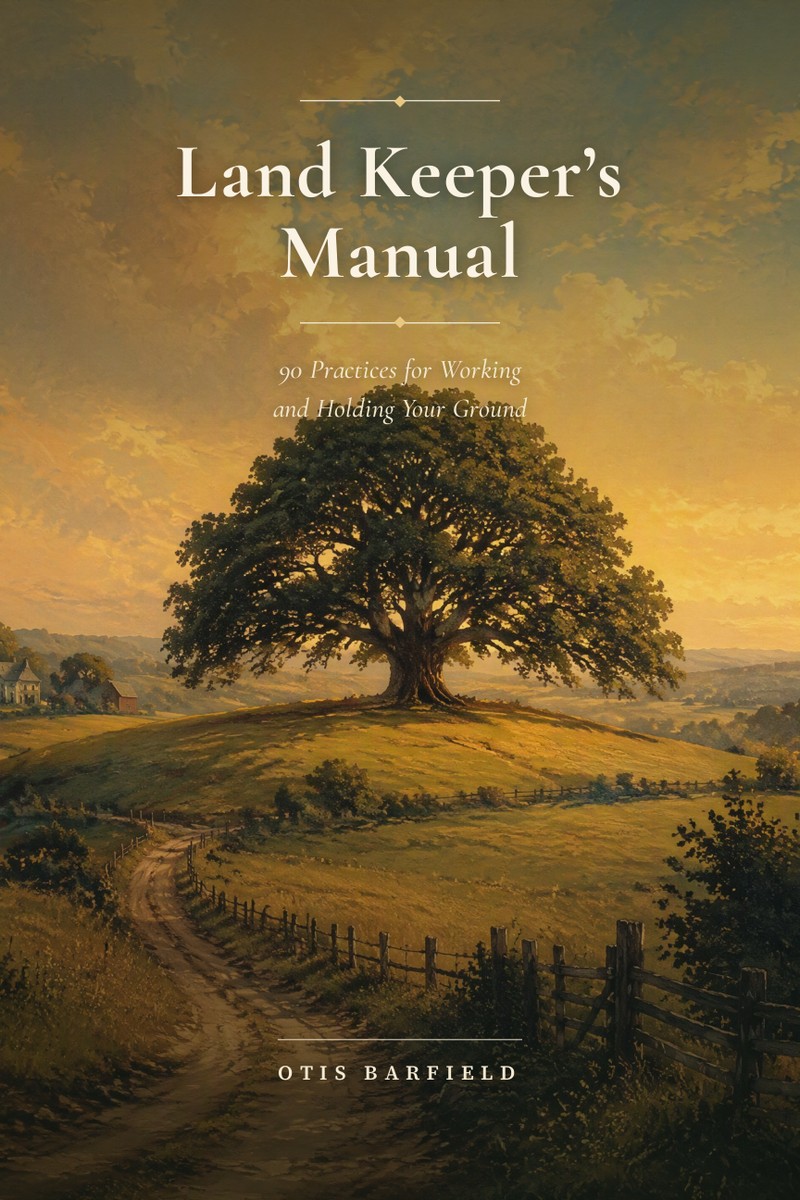
Ninety practices on the deed, the courthouse, the tax clock, the fence line, and the family meeting. Every one of them tells you what goes wrong, what to do about it in order, and when to stop and hire somebody.
“You do not sign anything on your porch. You take the paper, you say you will look at it, and you call somebody.”
Land Keeper's Manual · page 7
There are good history books about how Black families in this country came to own land, and how most of that land got away from them. You should read them. This is not one of them.
This book is about the paper, the courthouse, the fence line, and the family meeting. It is about what you do on Monday morning.
It assumes you either own land, expect to inherit land, or are one of a dozen cousins who all have a claim to the same forty acres and none of you are sure what that means. It assumes nobody ever walked you through the deed. It assumes you have heard the phrase “heirs' property” and were not sure whether it applied to your family — or had never heard it at all.
All of that is normal, and it is not because anybody was careless. For a long time the courthouse was not a safe place for our families to go, and lawyers cost money that could feed people instead. So the land got passed down the way it got passed down: by understanding, by respect, by everybody knowing whose row was whose. That system held for a while. It does not hold in a courtroom.
Ninety practices fix that, one piece of paper at a time.

This is the other thing: the map and the vocabulary, so that when you do walk into a lawyer's office, you walk in holding something.
Each part builds on the one before it. Work them in any order — or start with the one that scares you most.
“I drove to the courthouse on a Tuesday with Practice 1 printed out and came home with a certified deed. Sixty-one years old and it was the first time I had ever seen it. My grandmother's name is spelled wrong on it. We are fixing that next.”
“We are nineteen cousins on eighty acres in two states. The heirship chart took me four months of phone calls and it is the first document our family has ever had that shows who everybody is. We had the meeting. Nobody is suing anybody.”
“The tax notice had been going to my uncle's old address since 2019. I found that out on page 74 and had it changed the same week. I do not want to think about how that ends if I had not read this.”
I have spent my life around land — working it, walking it, and sitting at kitchen tables while families tried to work out what they had. What I kept seeing was not carelessness. It was good people who had never been shown the paper, and who found out too late that the courthouse does not care what everybody knew.
So I wrote down the ninety things I wish somebody had walked my own family through. What to ask for. What it costs. What the words mean. Which trip you make yourself, and which phone call has to be to an attorney in your state.
Every practice in here ends the same way — with the limits. What it does not fix. Where it goes wrong. When to stop and hire somebody. I put that in on purpose. A manual that never tells you to call a lawyer is a manual that will get you hurt.
If you take one thing from all ninety of them, take this one: you do not sign anything on your porch. That single habit has saved more family land than every other practice in this book put together.
One file. Ninety practices. Read it on the phone in the courthouse parking lot if that is where you are.
No, and it says so on page 7. I am not a lawyer and this book cannot be legal advice. Land law is state law, and in many places it is county practice on top of state law — the correct answer in one county can be the wrong answer two hours down the road. What this gives you is the map and the vocabulary: what to look for, what the terms mean, what to ask, and which of your problems need a licensed attorney in your state. Where I say “check your state,” I mean it literally.
A video is a story about one family's trouble. The manual is the order you do things in. Ninety practices, cross-referenced, each one with its steps and its limits, so you are not trying to remember which video had the part about the tax notice while you are standing at the clerk's window. It is the thing you keep in the land file.
Because lawyers cost money that could feed people, and that is half the reason this problem exists. A family that walks into a lawyer's office already holding a deed, a tax card, an heirship chart, and a clear question pays a fraction of what a family pays walking in with a shoebox and a story. $27 is the launch price; it goes to $47 when the launch ends.
Yes, with the caution built into every practice. The steps — pull the deed, chart the heirs, fix the tax notice, mark the line — are the same everywhere. The deadlines, the forms, and the names of the offices differ. The book tells you where that happens instead of pretending there is one answer, and it points you to the three free places that will tell you your state's version: the clerk of court, your state's legal aid office, and the extension agent at the nearest 1890 land-grant university.
That is the most common place to start, and Part One is built for it. By the end of those twelve practices you will know what your family actually owns on paper, which is more than most families can say. Part Two then tells you plainly whether the heirs' property chapters apply to you.
A PDF of the complete 151-page illustrated first edition, delivered by Gumroad the moment you buy. No app, no login, no waiting on the mail. Read it on a phone, a tablet, or a computer, or print the practices you are working on and put them in the land file.
Ninety practices on the deed, the courthouse, the tax clock, and the fence line — $27 during launch instead of $47. The families who kept their land are not the ones who knew more. They are the ones who had it in writing.
Get the Manual — $47 $27